
Moody's Analytics predicts India will remain the fastest-growing major economy in 2026 and 2027, but its pace will moderate due to a global slowdown, geopolitical risks, and financial market volatility, despite the boost from AI demand.

The World Bank has increased India's economic growth projection for FY27 to 6.6 per cent, citing resilient domestic demand, while simultaneously cutting its global economic growth outlook due to the conflict in West Asia.

The International Monetary Fund (IMF) has reduced India's growth forecast for FY27 to 6.4 per cent, citing the potential impact of higher energy prices offsetting the country's economic resilience. Despite this, India remains among the fastest-growing major economies.
The Reserve Bank of India (RBI) has projected a 6.9 per cent GDP growth for the current financial year, citing concerns over commodity prices and supply chain disruptions stemming from the West Asia crisis.

Tata Motors is set to acquire Italy's Iveco Group, a strategic move aimed at propelling the Indian automaker into the top four global commercial vehicle (CV) manufacturers, with projected annual revenues of $35 billion-$40 billion within five years.

S&P Global Ratings warns that a sustained rise in crude oil prices to $130 per barrel could significantly slow India's economic growth, weaken fiscal metrics, and strain corporate and banking sector performance, potentially reducing growth by up to 80 basis points.

The Asian Development Bank (ADB) has revised down India's GDP growth forecast for fiscal year 2026-27 (FY27) to 6.6 per cent from an earlier 6.9 per cent, primarily attributing the change to elevated energy prices stemming from the Middle East conflict. Despite this moderation, India is still expected to remain the world's fastest-growing major economy.
The OECD projects India's GDP to grow at 7.6% in the current fiscal year and 6.1% in 2026-27, despite global economic challenges stemming from the Middle East conflict and energy price volatility.

India's economy is projected to maintain growth above 7 per cent in 2026-27 (FY27), supported by strong domestic consumption and investment, even as global growth faces risks from geopolitical tensions, according to industry body Assocham.

The Indian rupee depreciated by 32 paise to close at 92.83 against the US dollar, influenced by escalating global tensions, particularly the US-Iran conflict, and the deadline for the RBI's instructions to banks to curb overnight positions.

A new survey indicates that Indian employers are planning to increase hiring in the April-June quarter, driven by strong business confidence and domestic demand. The survey also highlights the impact of AI adoption on workforce strategy and the challenges of talent scarcity.

Goldman Sachs has materially lowered its earnings growth forecast for Indian companies by a cumulative 9 percentage points over the next two years.

India's leading passenger vehicle manufacturers are significantly increasing investments and factory capacities, alongside planning major product launches for FY27, driven by strong confidence in sustained domestic demand growth despite global geopolitical tensions and supply chain risks.

'The West Asia or the Gulf crisis has shown that what we develop as national infrastructure when things are not as bad as they could be, we forget to plan for adversities.'

Biocon aims to become the world's leading insulin company, capitalising on larger pharmaceutical rivals' strategic shift towards newer, high-margin GLP-1 diabetes therapies. The company plans to expand its insulin presence across 80 markets, focusing on value maximisation and addressing the indispensable need for insulin, particularly for Type-1 and late-stage Type-2 diabetics.
S&P Global Ratings projects India's economic growth to slow to 6.6 per cent in FY27, down from 7.7 per cent in FY26, citing energy stress and a potential sub-par monsoon.

Most members of the Reserve Bank of India's Monetary Policy Committee (MPC) expressed concerns about inflation becoming generalised and highlighted uncertainties surrounding both inflation and growth prospects due to the West Asia conflict, according to the recently released minutes.

India's finance ministry anticipates inflation will remain relatively contained in the coming months, supported by a correction in crude oil prices and softening input costs following the cessation of the West Asia conflict, despite earlier spikes in wholesale and retail inflation.

Moody's Ratings has reduced India's GDP growth forecast for 2026 to 6 per cent, citing subdued private consumption, capital formation, and industrial activity due to higher energy costs and global uncertainties.

'The day that the market realises that they've overspent (on AI) and there's a sudden collapse in the capex, then India can start outperforming again.'

India is projected to attract between $80 and $85 billion through the Reserve Bank of India's (RBI) concessional swap facility, designed to boost foreign currency inflows, according to an SBI research report.

State-run Oil and Natural Gas Corporation (ONGC) has approved the development of a 1.75 million tonnes (mt) strategic petroleum reserve (SPR) in Mangaluru, a project deemed of national importance, with plans for broad commercial utilisation.

Foreign Currency Non-Resident (Bank), or FCNR (B), deposits mobilised under the Reserve Bank of India's (RBI's) concessional swap facility may have already surpassed the amount raised during the 2013 scheme in just about 45 days, prompting SBI Research to sharply raise its estimate for inflows under the facility to $65-70 billion.

India's wholesale price inflation (WPI) increased to 9.87 per cent in June, up from 9.68 per cent in May, primarily due to significant price increases in non-food and food products, with food inflation alone rising to 5.49 per cent.
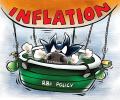
The Reserve Bank of India has increased its retail inflation projection for 2026-27 to 5.1 per cent, up from an earlier estimate of 4.6 per cent. This revision is primarily attributed to mounting input costs, driven by the pass-through of higher global energy prices to domestic petrol and diesel rates, which have seen significant increases since May.

Bharat Forge reported modest Q4FY26 results but provided strong guidance, anticipating significant growth from its defence, aerospace, and data centre segments, with a projected 25 per cent revenue growth in Indian manufacturing for FY27, despite current high valuations.

Analysts have largely maintained a bullish outlook on HDFC Bank and ICICI Bank following their Q4FY26 results, though their perspectives on future growth drivers differ. HDFC Bank's near-term performance is tied to accelerating loan growth, while ICICI Bank is seen as a strong candidate for a valuation rerating.

'I don't see fear becoming a dominant factor for retail investors.'

Analysts predict that inflation data, the US Federal Reserve's interest rate decision, and crude oil price trends will be the primary factors influencing the movement of Indian stock markets. Geopolitical developments, particularly the US-Iran deal, and foreign investor activity will also play a crucial role.

Tata Steel is strategically positioned for growth, leveraging India's robust steel demand, significant cost transformation programmes, and favourable protectionist policies in the EU and UK. The company is expanding its India capacity and optimising operations in its European units to enhance profitability and reduce debt.

India's wholesale price index (WPI) inflation surged to 9.68 per cent in May, up from 8.26 per cent in April, primarily due to significant increases in the prices of fuel and power, manufactured goods, and food items.
S&P Global Ratings has increased India's GDP growth forecast for the next fiscal year to 7.1 per cent, citing private consumption, investment, and exports as key drivers. However, the agency also cautioned that the conflict in the Middle East could strain India's fiscal position due to higher energy prices.

Commerce and Industry Minister Piyush Goyal announced that India expects to operationalise nine free trade agreements (FTAs) within the next 10 months, with plans for an additional three to four significant pacts over the coming year, reinforcing India's ambition to become a global manufacturing and investment hub.

Indian IT services firms are expected to report a soft Q1 FY27 performance due to a challenging macro environment, the impact of AI, and geopolitical uncertainties, leading to reduced discretionary spending and slower decision-making cycles, according to Motilal Oswal Financial Services.
India's retail inflation rose to 4.38 per cent in June, driven primarily by costlier food items, pushing it above the Reserve Bank of India's median target of 4 per cent for the first time under the new series.

ExlService Holdings, a data and AI company, announced its acquisition of AI data solutions firm iMerit for up to USD 310 million. This strategic move aims to accelerate AI innovation, deepen EXL's AI capabilities in model training and evaluation, and expand its market presence in high-growth AI tech sectors. The transaction is expected to conclude in Q3 2026.

India's hydropower generation has been significantly constrained in July due to the El Nio effect, which has weakened the southwest monsoon and reduced reservoir levels. This decline, following a 21 per cent year-on-year drop in June 2026, is forcing greater reliance on coal generation and straining grid flexibility amidst rising power demand.

Adani Group Chairman Gautam Adani announced a capital expenditure programme of over 2 trillion for Adani Power, aiming for 45 gigawatts (Gw) capacity in five years, including a significant entry into nuclear power with a target of 10 Gw by 2035 through Adani Atomic Energy.
Chief Economic Advisor V Anantha Nageswaran stated that India's economy is projected to return to a 7 per cent-plus growth trajectory by 2027-28 (FY28), or sooner if external conditions improve, despite near-term challenges from the West Asia crisis.

The Economic Survey on Thursday projected the GDP growth in the range of 6.8 to 7.2 per cent in 2026-27, a tad lower than 7.4 per cent estimated in the current fiscal.
